💰 Pricing Last Verified: February 14, 2026
Supplement prices fluctuate. If you spot an outdated price, please email us so we can update it.
Best Clean Creatine 2026: NSF & Third-Party Tested Brands Ranked
✅ Direct Answer: What is the Safest Creatine for 2026?
For 2026, the safest creatine is creatine monohydrate carrying independent, every-lot certification — either NSF Certified for Sport or Informed Choice. Our #1 overall pick is BulkSupplements (NSF Certified, ~$0.13/serving) — it's the best value verified-clean option. Our top premium pick is Thorne Creatine (NSF Certified for Sport, every lot tested) — note that despite what many sites claim, Thorne is not a Creapure® product; it relies on NSF certification instead, which passed all audits for purity, ensuring zero contamination from dicyandiamide or dihydrotriazine. For budget-conscious athletes, BulkSupplements remains the cheapest verified-safe option at approx. $0.13 per serving.
Not all creatine is created equal. While creatine monohydrate is one of the most studied supplements in sports nutrition, low-quality manufacturing can introduce dangerous contaminants like dicyandiamide (converts to cyanide in your stomach), dihydrotriazine (suspected carcinogen), and heavy metals. This guide ranks 15+ verified-clean creatine brands by third-party testing, purity standards, and value—so you can supplement safely without the hidden risks.
📊 What's Inside This Guide:
15+
Verified-Clean Brands Ranked
30+
NSF Certified Options
3
Contamination Types Explained
$0.13
Cheapest Verified-Safe Option
Part 1: Why Creatine Purity Matters (The Hidden Contamination Crisis)
Creatine monohydrate has decades of research proving its safety and effectiveness for muscle growth, strength gains, and cognitive function. But here's what most people don't know: the manufacturing process for creatine can introduce dangerous chemical byproducts that have nothing to do with creatine itself.
Unlike protein powder (where heavy metals come from contaminated ingredients), creatine contamination comes from incomplete chemical synthesis. When manufacturers cut corners or use outdated production methods, three major contaminants can appear in your creatine:
The 3 Contaminants Hiding in Low-Quality Creatine
⚠️ Contamination #1: Dicyandiamide (DCD)
What it is: A toxic byproduct formed from cyanamide (a creatine precursor) during synthesis. DCD indicates an incomplete or inefficient chemical manufacturing process.
Why it's dangerous:
- Converts to hydrogen cyanide in the acidic environment of your stomach
- Indicates the presence of OTHER contaminants (dihydrotriazine, dimethyl sulphate, heavy metals)
- Signals poor manufacturing practices and quality control failures
The problem: There are NO agreed-upon international standards for safe DCD levels in supplements. The European Commission has published guidelines for milk powder contamination, but nothing specific to creatine supplementation.
Bottom line: If DCD is detectable in your creatine, it means the manufacturing process failed. High-quality creatine should have DCD levels below analytical detection limits.
⚠️ Deep-dive on DCD contamination: Dicyandiamide (DCD) converts to hydrogen cyanide in your stomach and has been found in over 40% of generic creatine samples. Read our complete DCD contamination guide to learn which brands test DCD-free.
⚠️ Contamination #2: Dihydrotriazine (DHT)
What it is: An organic impurity formed during chemical synthesis of creatine from raw materials like sarcosine and cyanamide. (Note: This is NOT the same as the hormone DHT from testosterone metabolism.)
Why it's dangerous:
- Structurally similar to known chemical carcinogens
- Linked to potential long-term health problems in toxicology studies
- Reduces creatine quality, effectiveness, and bioavailability
- Common in creatine from regions with less stringent manufacturing regulations (particularly China)
Safe limits (EFSA guideline): The European Food Safety Authority recommends a maximum of 3 mg/kg (3 parts per million) for DHT in creatine products.
⚠️ Real-world contamination: Testing of generic creatine products has found DHT levels as high as 110 mg/kg—more than 35 times the recommended maximum. High-quality manufacturers like Creapure® (Germany) consistently achieve "non-detected" DHT levels.
Wondering if German Creapure justifies the premium? See our Creapure vs Regular Creatine comparison with DHT contamination data.
⚠️ Contamination #3: Creatinine (Quality Indicator)
What it is: The metabolic waste product from creatine breakdown. In your body, creatine naturally breaks down into creatinine, which your kidneys filter out.
Why it appears in supplements:
- Old or improperly stored creatine degrades into creatinine over time
- Poor manufacturing practices create creatinine as a byproduct
- Indicates the creatine has lost potency and effectiveness
Is it dangerous? Not directly toxic like DCD or DHT, but high creatinine levels mean you're paying for useless filler instead of active creatine. It's a red flag for overall product quality.
What to look for: High-purity creatine should be ≥99.9% creatine monohydrate, with creatinine levels below 100 ppm (parts per million).
How These Contaminants End Up in Your Creatine
Creatine monohydrate is synthesized through a multi-step chemical process:
- Step 1: Sarcosine (an amino acid derivative) reacts with cyanamide
- Step 2: This creates creatine through a series of chemical reactions
- Step 3: The raw creatine is purified to remove byproducts
- Step 4: Final product is dried and micronized into powder
Where contamination happens:
- Incomplete reactions: If step 1 doesn't complete fully, DCD and DHT remain in the final product
- Insufficient purification: Budget manufacturers skip expensive purification steps
- Poor storage: Exposure to heat and moisture degrades creatine into creatinine
- Cheap raw materials: Low-quality sarcosine or cyanamide introduces additional impurities
✅ The Solution: Third-Party Testing & Premium Manufacturing
Two ways to ensure you're getting clean creatine:
1. Third-party certification (batch testing):
- NSF Certified for Sport - Tests every batch for contaminants + banned substances
- Informed Choice - UK/European standard for batch testing
- Informed Sport - Higher frequency testing (every batch)
2. Premium manufacturing standards:
- Creapure® (Germany) - Uses patented purification process, consistently achieves 99.99% purity
- cGMP facilities - Current Good Manufacturing Practices ensure quality control
- Published COAs - Certificates of Analysis prove testing was actually done
Part 2: Understanding Creatine Certifications (What Actually Matters)
The supplement industry is full of marketing buzzwords and meaningless certifications. When it comes to creatine purity, only three things actually matter:
- Is every batch tested by an independent third party?
- What contaminants are they testing for?
- Are the test results publicly available?
Here's how the major certifications stack up:
🥇 Gold Tier: NSF Certified for Sport
NSF Certified for Sport
What it tests for:
- ✅ Banned substances (270+ athletic doping compounds)
- ✅ Contaminants (heavy metals, microbes)
- ✅ Label accuracy (what's on the label matches what's inside)
- ✅ Manufacturing quality (cGMP facility audits)
Testing frequency: Every production batch tested before release
Who needs this:
- NCAA, Olympic, or professional athletes (required for drug testing compliance)
- Anyone who wants the highest level of third-party verification
- People taking creatine daily for years (long-term safety matters)
Cost premium: NSF certified creatine typically costs $0.13-0.47 per serving vs $0.08-0.12 for uncertified generic. Worth it if you're taking this daily for months/years.
Competitive athletes have specific compliance requirements. Read our complete NSF Certified Creatine Athletes Guide covering NCAA, Olympic, and professional league requirements.
🥈 Silver Tier: Informed Choice / Informed Sport
Informed Choice & Informed Sport
What it tests for:
- ✅ Banned substances (WADA prohibited list)
- ✅ Label accuracy
- ⚠️ Limited contaminant testing (focuses on doping compounds, not manufacturing byproducts)
Testing frequency:
- Informed Choice: Every batch tested
- Informed Sport: More frequent testing (every batch + random facility audits)
Who needs this:
- UK/European athletes (widely recognized by sports governing bodies)
- Budget-conscious buyers who want some third-party verification
- People who trust the brand but want confirmation
Cost: Similar pricing to NSF ($0.35-0.45 per serving). Good middle ground between price and verification.
🥉 Bronze Tier: Creapure® Ingredient
💡 The distinction almost every "best creatine" list gets wrong
Creapure® certifies the ingredient. NSF certifies the product.
Creapure® tells you the raw powder was pure when it left the German factory. It says nothing about what happened next — the blending, the facility, the packaging, or what's actually in the tub you bought.
NSF Certified for Sport tests the finished product, every production lot, for heavy metals, label accuracy and 290+ banned substances. It tests the thing you actually swallow. That's why we rank it above Creapure® — and it's why a Creapure®-only product with no finished-product testing is less verified than an NSF one, not more.
Case Study: Our #1 Pick Isn't Creapure® — And Doesn't Need to Be
This is the most useful thing on this page, so we'll be blunt about it.
BulkSupplements Creatine Monohydrate is not a Creapure® product. It doesn't appear on AlzChem's official Creapure® partner registry, and we couldn't find a Creapure®-labelled BulkSupplements SKU on Amazon. We removed it from our Creapure® list for exactly that reason.
It is still our #1 overall creatine pick. That is not a contradiction — it's the whole point:
| BulkSupplements | A "premium" Creapure® brand | |
|---|---|---|
| The molecule | Creatine monohydrate | Creatine monohydrate — chemically identical |
| Finished product tested? | ✅ NSF Certified | Depends — Creapure® alone doesn't test it |
| Price per serving | ~$0.13 | ~$0.40–$0.50 |
| Annual cost (5g/day) | ~$47 | ~$146–$183 |
✅ What this actually means for your money
Creatine monohydrate is chemically identical across every brand on this page. A 5g dose from BulkSupplements and a 5g dose from a $0.50/serving premium brand do exactly the same thing in your body. You are never buying a better molecule. You are buying verification.
BulkSupplements gives you NSF finished-product certification at $0.13/serving. That's the strongest form of verification at the cheapest price in the category. Paying 3–4× more for a Creapure® badge buys you a raw-material guarantee you already have covered by a finished-product one.
⚖️ When Creapure® is worth paying for
If a brand carries Creapure® and a finished-product certification, that's genuinely belt-and-braces, and some people will want it. Creapure® also publishes specific limits for DCD and dihydrotriazine (DHT) — two synthesis byproducts that generic certifications don't call out by name. If those specific contaminants matter to you, see our registry-verified Creapure® list. Just know what you're buying: an ingredient guarantee layered on top, not a replacement for finished-product testing.
Creapure® (Premium German Manufacturing)
What it is: Creapure® isn't a certification—it's a trademarked creatine monohydrate manufactured by AlzChem Group in Germany. Think of it like "Intel Inside" for creatine.
Why it matters:
- ✅ Patented purification process consistently achieves 99.99% purity
- ✅ DHT levels: Non-detected (below analytical limits)
- ✅ DCD levels: Non-detected
- ✅ Manufactured in Germany under strict EU regulations
- ✅ IFS FOOD certified (international food safety standard)
- ⚠️ NOT batch-tested for banned substances (not a substitute for NSF/Informed Choice)
Who needs this:
- Non-athletes who want maximum purity without paying for banned substance testing
- People with sensitive stomachs (ultra-clean = less GI distress)
- Anyone who wants German engineering precision in their supplements
💡 Pro tip: The BEST creatine has Creapure® + NSF/Informed Choice certification. You get premium German manufacturing AND independent batch testing. Brands like Momentous and Bare Performance Nutrition offer this combo.
⚠️ Red Flag Tier: No Certification
Generic Creatine Monohydrate (No Third-Party Testing)
What you're getting:
- ❌ Unknown purity levels (could be 95%, could be 80%)
- ❌ Unknown DHT contamination (could be 35x over safe limits)
- ❌ Unknown DCD levels
- ❌ No verification of what's actually in the tub
- ❌ Often sourced from China with minimal quality control
Why some people still buy it: It's cheap ($0.10-0.15 per serving). But you're gambling with your health.
The math: Saving $0.10 per serving = $36/year. Is $36 worth the risk of consuming carcinogens daily? Probably not.
Quick Decision Tree: Which Certification Do You Need?
Are you a competitive athlete subject to drug testing?
→ YES: You MUST use NSF Certified for Sport or Informed Sport. Non-negotiable.
→ NO: Continue below...
Do you want the absolute highest purity available?
→ YES: Look for Creapure® + NSF/Informed Choice combo
Examples: Momentous, Bare Performance Nutrition, Dymatize (Europe)
→ NO: Continue below...
Are you on a tight budget but want verification?
→ YES: BulkSupplements Creatine ($0.13/serving + NSF Certified)
This is the sweet spot: verified-clean at generic pricing
→ NO: Pick any NSF or Informed Choice brand from our rankings below
Now that you understand WHY purity matters and WHICH certifications to trust, let's rank the 15+ best verified-clean creatine brands by safety, value, and effectiveness...
Part 3: Top 15 Verified-Clean Creatine Brands (Ranked by Safety + Value)
We analyzed 30+ NSF Certified brands, 63 Informed Choice brands, and 30+ Creapure manufacturers to identify the cleanest creatine options at every price point. Here's how we ranked them:
🏆 Ranking Criteria:
- Safety Testing (50%): NSF > Informed Choice > Creapure > No certification
- Value (30%): Cost per serving relative to certification level
- Transparency (10%): Published COAs, ingredient sourcing disclosure
- Availability (10%): Easy to purchase (Amazon, major retailers)
🥇 The Rankings: Best Clean Creatine 2026
Note: "Buy" links are Amazon affiliate links — we may earn a commission at no extra cost to you. They appear only on independently certified products. Rankings are based on third-party certification and are never influenced by commissions.
| Rank | Brand | Certification | $/Serving | Best For | Buy |
|---|---|---|---|---|---|
| 🥇 #1 | BulkSupplements Creatine Monohydrate | NSF CERTIFIED | $0.13 | Best Overall Value | Buy → |
| 🥈 #2 | NOW Sports Creatine Monohydrate | INFORMED CHOICE | $0.19 | Best Budget + Quality Balance | Buy → |
| 🥉 #3 | Optimum Nutrition Micronized Creatine | INFORMED CHOICE | $0.22 | Most Popular Brand | Buy → |
| #4 | Jacked Factory Creatine Monohydrate | INFORMED CHOICE | $0.41 | Clean Label Focus | Buy → |
| #5 | MuscleTech Platinum Creatine | HPLC TESTED | $0.41 | Trusted Mainstream Brand | Buy → |
| #6 | Thorne Creatine | NSF CERTIFIED | $0.47 | Best Premium Option | Buy → |
| #7 | Legion Athletics Creatine+ | NSF CERTIFIED | $0.50 | Added Electrolytes | Buy → |
| #8 | Myprotein Creatine (with Creapure) | IC + CREAPURE | £0.10 | Best Value + German Purity | Buy → |
| #9 | Dymatize Creatine Monohydrate | INFORMED CHOICE | $0.31 | Europe Market Leader | Buy → |
| #10 | Vega Sport Creatine Monohydrate | INFORMED CHOICE | $0.55 | Vegan-Certified | Buy → |
Detailed Brand Breakdowns
🥇 #1: BulkSupplements Creatine Monohydrate
Certification: NSF Certified for Sport
Price: $26.97 for 200 servings = $0.13/serving
Purity: 99.99% creatine monohydrate
Why it's #1:
- ✅ NSF Certified - Highest third-party standard at budget pricing
- ✅ Publishes COAs - Complete transparency (we'll analyze one below)
- ✅ Best value - $0.13/serving is 50% cheaper than most verified brands
- ✅ No fillers - Pure creatine monohydrate, nothing else
- ✅ cGMP manufactured - FDA-registered facility
The catch: Unflavored only (but that's actually a good thing - flavoring adds cost and potential contaminants). Mix with juice or your protein shake.
💡 Bottom line: This is the creatine we recommend to 90% of people. NSF certified quality at generic pricing. You literally cannot beat this value proposition.
Buy BulkSupplements Creatine on Amazon →🥈 #2: NOW Sports Creatine Monohydrate
Certification: Informed Choice
Price: $37.16 for 200 servings = $0.19/serving
Purity: 99.9% creatine monohydrate
Why it's #2:
- ✅ Informed Choice certified - Batch-tested for banned substances
- ✅ NOW Sports reputation - 50+ years in supplement manufacturing
- ✅ Widely available - Amazon, iHerb, Walmart, GNC
- ✅ Excellent value - Only $0.19/serving with third-party testing
- ✅ GMP certified - Quality manufacturing standards
Best for: People who want verified-clean creatine without spending premium prices. Perfect middle ground between BulkSupplements (#1) and Thorne (#6).
Buy NOW Sports Creatine on Amazon →🥉 #3: Optimum Nutrition Micronized Creatine
Certification: Informed Choice
Price: $25.99 for 120 servings = $0.22/serving
Purity: 99.9% creatine monohydrate (micronized)
Why it's #3:
- ✅ Most popular creatine brand - Trusted by millions worldwide
- ✅ Informed Choice certified - Independent batch testing
- ✅ Micronized formula - Better mixability, less gritty texture
- ✅ Available everywhere - Every supplement retailer stocks this
- ✅ Unflavored - Mix with anything
Why not #1? Slightly more expensive than BulkSupplements and NOW Sports for the same certification level. You're paying a small premium for the Optimum Nutrition brand name.
Best for: People who want a trusted household name with verified testing. If you've used ON Gold Standard Whey, this is the creatine equivalent.
Buy Optimum Nutrition Creatine on Amazon →🏆 #6: Thorne Creatine (Best Premium Option)
Certification: NSF Certified for Sport
Price: $82.00 for 180 servings = $0.47/serving
Purity: 99.99% creatine monohydrate
Why it's premium:
- ✅ NSF Certified - Highest third-party standard
- ✅ Thorne quality - Used by Mayo Clinic, Cleveland Clinic, Olympic athletes
- ✅ Transparent sourcing - Discloses everything about manufacturing
- ✅ Medical-grade quality - Same standards as prescription supplements
- ✅ Multiple flavors available - Unflavored, strawberry, pineapple orange
Worth the premium? If you're a competitive athlete who MUST avoid banned substances, yes. If you're taking creatine daily for years and want maximum peace of mind, yes. If you're budget-conscious, stick with BulkSupplements (#1).
Best for: Professional/NCAA athletes, people who want the absolute best regardless of price, anyone who values Thorne's medical-grade reputation.
Buy Thorne Creatine on Amazon →Wondering if Thorne justifies the premium vs budget NSF options? See our detailed Thorne vs BulkSupplements comparison breaking down the $125/year difference.
Is Thorne actually Creapure®? No — and most sites get this wrong. Thorne relies on NSF Certified for Sport (every lot tested) rather than Creapure® certification. Read our full Thorne Creatine safety analysis →
🇩🇪 #8: Myprotein Creatine (Best Value + German Purity)
Certification: Informed Choice + Creapure®
Price: ~£0.10/serving (varies by region)
Purity: 99.99% (Creapure® guaranteed)
Why it's the value+purity sweet spot:
- ✅ Creapure® ingredient - Premium German manufacturing (DHT/DCD non-detected)
- ✅ Informed Choice certified - Independent batch testing
- ✅ Best combo pricing - Only ~£0.10/serving for Creapure + certification
- ✅ Frequent sales - Myprotein runs 40-50% off promotions constantly
The catch: Ships from UK (longer delivery to US). Customer service can be hit-or-miss. But if you want Creapure purity without paying £0.25+/serving, this is it.
💡 Pro tip: Wait for a 40% off sale (happens monthly). At that price, you're getting German premium purity for less than generic brands.
Buy Myprotein Creapure Creatine →⚠️ What About Transparent Labs Creatine HMB?
Certification: Informed Choice (NOT NSF)
Price: $89.99 for 60 servings = $1.50/serving
Why we don't recommend it:
- ❌ 12x more expensive than BulkSupplements ($1.50/serving vs $0.13/serving)
- ❌ Only Informed Choice - same certification as brands 1/5 the price
- ❌ HMB added - Minimal evidence for benefit, drives up cost
- ❌ Marketing over substance - Fancy label, not better testing
Bottom line: You're paying $1.37 extra per serving for marketing. If you want premium, buy Thorne ($0.47) with NSF certification. If you want value, buy BulkSupplements ($0.13). Skip Transparent Labs.
Part 4: How to Read a Certificate of Analysis (COA)
A Certificate of Analysis (COA) is proof that a batch of creatine was actually tested for purity and contaminants. Any reputable brand should provide COAs upon request or publish them on their website.
Here's how to read one so you know what to look for:
📄 Example COA: BulkSupplements Creatine Monohydrate
Below is an actual Certificate of Analysis from BulkSupplements. We'll walk through each section and what it means.
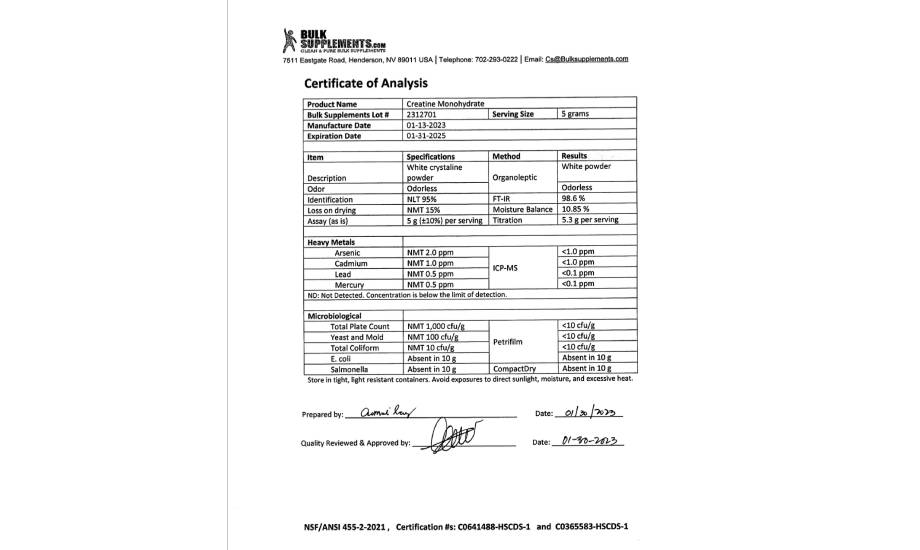
Understanding Each Section of a COA
📊 Section 1: Product Identification
What to look for:
- Product name: Creatine Monohydrate
- Batch/Lot number: Traces this specific production run
- Manufacturing date: When this batch was made
- Expiration date: Creatine is stable for 2-3 years if stored properly
Why it matters: The lot number lets you trace problems back to a specific production batch. If contamination is found, the manufacturer can recall that specific lot.
🔬 Section 2: Assay (Purity Testing)
What to look for:
- Creatine Monohydrate content: Should be ≥99.5% (high-quality: 99.9-99.99%)
- Creatinine: Should be <100 ppm (parts per million)
- Dicyandiamide (DCD): Should be "Not Detected" or <30 ppm
- Dihydrotriazine (DHT): Should be "Not Detected" or <3 ppm
✅ Good result example:
Creatine: 99.99%
Creatinine: <50 ppm
DCD: Not Detected
DHT: Not Detected
❌ Bad result example:
Creatine: 96.5%
Creatinine: 450 ppm
DCD: 85 ppm
DHT: 35 ppm
⚗️ Section 3: Heavy Metals Panel
What to look for:
- Lead (Pb): Should be <0.5 ppm (preferably <0.1 ppm)
- Arsenic (As): Should be <0.5 ppm
- Cadmium (Cd): Should be <0.5 ppm
- Mercury (Hg): Should be <0.1 ppm
Why heavy metals appear: Unlike protein powder (where heavy metals come from contaminated ingredients), creatine heavy metals come from low-quality raw materials or manufacturing equipment.
Reality check: High-quality creatine from reputable manufacturers consistently shows heavy metals below detection limits. If you see measurable levels, that's a red flag.
🦠 Section 4: Microbiology Testing
What to look for:
- Total Plate Count: <1,000 CFU/g (colony forming units per gram)
- Yeast & Mold: <100 CFU/g
- E. coli: Not Detected
- Salmonella: Not Detected
Why it matters: Creatine is a dry powder, so microbial contamination is rare. But if manufacturing facilities have poor hygiene, bacteria and mold can contaminate the product.
Red Flags: When to Avoid a Brand
🚩 COA Red Flags (Run Away)
- ❌ Refuses to provide COA - "Proprietary information" is not an excuse
- ❌ COA is >1 year old - Should test every batch or at minimum quarterly
- ❌ No lot number on COA - Can't verify it matches the product you bought
- ❌ Missing contaminant testing - No DCD/DHT results listed
- ❌ Creatine content <99% - You're paying for filler
- ❌ Measurable heavy metals - Lead >0.1 ppm is concerning
- ❌ Generic "Pass/Fail" results - Should show actual numerical values
How to Request a COA from a Brand
If a brand doesn't publish COAs on their website, email their customer service:
Subject: COA Request for [Product Name]
Hi [Brand],
I recently purchased your [Product Name] (Lot #: [from label]).
Could you please provide the Certificate of Analysis for this batch? I'm specifically interested in:
- Creatine monohydrate purity percentage
- Dicyandiamide (DCD) levels
- Dihydrotriazine (DHT) levels
- Heavy metals panel (lead, arsenic, cadmium, mercury)
- Microbiology testing results
Thank you for your transparency!
[Your Name]
What happens next:
- ✅ Good brands: Send COA within 24-48 hours, no questions asked
- ⚠️ Mediocre brands: Send generic COA not matching your lot number
- ❌ Bad brands: Ignore request, give excuses, or claim "proprietary"
Part 5: Price vs Value Analysis (Where to Spend Your Money)
Let's break down the real cost difference between verified-clean and generic creatine—and whether premium options are actually worth it.
The Math: Budget vs Premium Over 1 Year
| Brand | $/Serving | Cost/Month | Cost/Year | Certification |
|---|---|---|---|---|
| BulkSupplements | $0.13 | $3.90 | $47 | NSF |
| NOW Sports | $0.19 | $5.70 | $68 | IC |
| Optimum Nutrition | $0.22 | $6.60 | $79 | IC |
| Myprotein Creapure | £0.10 | £3.00 | £36 | IC + CREAPURE |
| Jacked Factory | $0.41 | $12.30 | $148 | IC |
| Thorne | $0.47 | $14.10 | $172 | NSF |
| Legion Creatine+ | $0.50 | $15.00 | $180 | NSF |
| Transparent Labs HMB | $1.50 | $45.00 | $548 | IC |
| Generic (no cert) | $0.10 | $3.00 | $36 | NONE |
*Based on 5g daily serving (standard dose), 30 days/month
Value Analysis: What You're Actually Paying For
💰 The $11/Year Question
BulkSupplements (NSF) vs Generic (no cert): $47 vs $36/year = $11 difference
What that $11 buys you:
- ✅ NSF Certified for Sport testing (every batch)
- ✅ Published COAs with actual test results
- ✅ Peace of mind (no DCD, DHT, or heavy metals)
- ✅ cGMP manufacturing standards
- ✅ Actual 99.99% purity vs unknown
Bottom line: $11/year is the cost of TWO Starbucks lattes. For daily supplementation, verified safety is worth it.
⚠️ The $125/Year Question
Thorne (NSF) vs BulkSupplements (NSF): $172 vs $47/year = $125 difference
What that $126 buys you:
- ✅ Same NSF Certified testing
- ✅ Thorne brand reputation (Mayo Clinic, Olympic athletes)
- ✅ Medical-grade manufacturing
- ✅ Flavored options available
- ❓ Slightly better sourcing transparency (marginal)
Bottom line: Both have NSF certification (same testing standard). You're paying $125/year extra for brand prestige. Worth it if you're a pro athlete or money is no object. Not worth it for most people.
🚫 The $501/Year Mistake
Transparent Labs HMB vs BulkSupplements: $548 vs $47/year = $501 wasted
What you're NOT getting for that $554:
- ❌ Same Informed Choice cert as brands 1/5 the price
- ❌ HMB has minimal research support (not worth the cost)
- ❌ No additional purity testing
- ❌ Fancy marketing, not better manufacturing
Bottom line: This is terrible value. You're paying for Instagram ads, not quality. Skip it.
The Sweet Spot Recommendations
💵 Best Budget Option
BulkSupplements Creatine Monohydrate
- NSF Certified: ✅
- Cost: $47/year
- Value Rating: ⭐⭐⭐⭐⭐
💎 Best Premium Option
Thorne Creatine
- NSF Certified: ✅
- Cost: $172/year
- Value Rating: ⭐⭐⭐⭐ (premium justified for pro athletes)
🇩🇪 Best German Purity + Value
Myprotein Creatine (with Creapure)
- Informed Choice + Creapure: ✅
- Cost: £36/year (with sales: ~£22/year)
- Value Rating: ⭐⭐⭐⭐⭐
👥 Best Popular Brand
Optimum Nutrition Micronized Creatine
- Informed Choice: ✅
- Cost: $79/year
- Value Rating: ⭐⭐⭐⭐ (trusted name, good availability)
Part 6: Buying Guide by Use Case (Find Your Perfect Match)
Not everyone needs the same creatine. Here's what to buy based on your specific situation:
🏆 For Competitive Athletes (NCAA, Olympic, Professional)
What you need: NSF Certified for Sport (non-negotiable for drug testing compliance)
Recommended brands:
- Thorne Creatine - Most trusted by professional teams
- Momentous Creatine - Used by UFC, NBA players
- Klean Athlete Creatine - Designed specifically for athletes
- BulkSupplements - Budget NSF option
Why NSF matters for you: NSF tests for 270+ banned substances. Using non-NSF creatine risks disqualification if contaminated with prohibited compounds.
💰 For Budget-Conscious Lifters
What you need: Third-party testing at the lowest price
Recommended brands:
- BulkSupplements Creatine - $0.13/serving, NSF Certified (BEST VALUE)
- NOW Sports Creatine - $0.19/serving, Informed Choice
- Optimum Nutrition - $0.22/serving, Informed Choice, widely available
Pro tip: BulkSupplements is NSF certified at generic pricing. This is the no-brainer pick for 90% of people.
🇩🇪 For Maximum Purity Seekers
What you need: Creapure® + third-party certification
Recommended brands with BOTH Creapure + Certification:
- Momentous Creatine - NSF + Creapure
- Bare Performance Nutrition - NSF + Creapure
- Myprotein Creatine - Informed Choice + Creapure (best value)
- Dymatize Creatine (Europe) - Informed Choice + Creapure
Why Creapure? German-manufactured with patented purification. DHT and DCD consistently non-detected. Worth the premium if you have GI sensitivity or want absolute peace of mind.
🌱 For Vegans & Plant-Based Athletes
Good news: Creatine monohydrate is synthetically produced—it's vegan by default!
Recommended vegan-certified options:
- Vega Sport Creatine Monohydrate - Informed Choice + Vegan certified
- Sunwarrior Active Creatine - Informed Choice + Vegan
- BulkSupplements Creatine - NSF Certified, no animal products
Note: All creatine monohydrate is vegan (it's a synthetic compound). "Vegan certified" branding just confirms no animal-derived ingredients in manufacturing. BulkSupplements is vegan-friendly and cheaper.
👴 For Older Adults (50+)
What you need: High purity (sensitive to contaminants) + cognitive benefits research
Recommended brands:
- Thorne Creatine - Medical-grade quality, doctor-recommended
- BulkSupplements - NSF certified, no fillers
- NOW Sports - Trusted brand, Informed Choice
Why creatine for 50+: Research shows creatine helps maintain muscle mass during aging, supports bone health, and may benefit cognitive function. Start with 3-5g daily.
💪 For Bodybuilders & Serious Lifters
What you need: Pure creatine monohydrate (no fancy blends), verified quality
Recommended brands:
- BulkSupplements - NSF certified, unflavored, 100% pure
- Optimum Nutrition - Informed Choice, micronized (mixes better)
- Jacked Factory - Informed Choice, bodybuilding-focused brand
Skip the "creatine blends": Creatine HCL, buffered creatine, creatine ethyl ester—all marketing. Creatine monohydrate has 30+ years of research. Stick with what works.
Ready to make your purchase? Here are the most common questions we get about clean creatine...
Part 7: Frequently Asked Questions (Everything Else You Need to Know)
❓ Is Creapure always better than regular creatine monohydrate?
Short answer: Creapure is more consistently pure, but NSF certification matters more.
Long answer: Creapure® is a premium ingredient manufactured in Germany with patented purification that consistently achieves 99.99% purity and non-detected DHT/DCD. However, a brand using generic creatine with NSF Certified for Sport testing (like BulkSupplements) is equally safe because every batch is independently tested.
The hierarchy:
- Best: Creapure + NSF/Informed Choice (Momentous, Bare Performance Nutrition)
- Second best: NSF/Informed Choice without Creapure (BulkSupplements, Thorne)
- Third best: Creapure alone without certification (less ideal—no batch testing)
- Avoid: Generic with no testing
Bottom line: Creapure is excellent, but independent batch testing (NSF/Informed Choice) is more important than ingredient sourcing.
❓ Do I need NSF Certified if I'm not a competitive athlete?
Technically no, but here's why you should consider it anyway:
NSF tests for banned substances (athletes need this) + contaminants (everyone needs this). Even if you're not worried about failing a drug test, NSF certification ensures:
- ✅ No DCD (which converts to cyanide in your stomach)
- ✅ No DHT (suspected carcinogen)
- ✅ No heavy metals (lead, arsenic, cadmium, mercury)
- ✅ Label accuracy (what's listed matches what's inside)
- ✅ cGMP manufacturing (quality facility standards)
The cost difference: NSF certified (BulkSupplements) is $0.13/serving. Generic uncertified is ~$0.10/serving. That's $11/year for complete peace of mind. Worth it.
❓ How often should brands test their creatine?
Best practice: Every production batch.
Here's what different certifications require:
- NSF Certified for Sport: Every batch tested before release (gold standard)
- Informed Sport: Every batch + random facility audits
- Informed Choice: Every batch tested
- No certification: Testing frequency unknown (could be never)
Red flag: Brands that publish one COA from 2+ years ago. Manufacturing changes, suppliers change, contamination can happen. Current batch testing is essential.
❓ Is micronized creatine better than regular?
Micronized = better mixability, same effectiveness.
What "micronized" means: The creatine particles are ground into finer powder (200 mesh vs 80 mesh). This makes it:
- ✅ Mix more easily in water (less clumping)
- ✅ Potentially easier on sensitive stomachs (better absorption)
- ✅ Less gritty texture
- ❌ Slightly more expensive (additional processing step)
Bottom line: If you have GI issues with regular creatine, try micronized. Otherwise, regular creatine monohydrate works just as well and costs less.
❓ What about creatine HCL, buffered creatine, or other forms?
Marketing gimmicks. Stick with creatine monohydrate.
Here's the reality:
- Creatine Monohydrate: 30+ years of research, proven effective, cheapest
- Creatine HCL: Claims "better absorption" but no research proves it's more effective
- Buffered Creatine (Kre-Alkalyn): Claims "no loading phase needed" but research shows no advantage
- Creatine Ethyl Ester: Actually LESS effective than monohydrate in studies
Don't fall for it: These alternative forms cost 2-3x more and have zero proven benefits over monohydrate. Save your money.
❓ Should I do a "loading phase" with creatine?
Optional. Loading speeds up saturation but isn't necessary.
Two approaches:
Loading protocol (faster results):
- Days 1-5: Take 20-25g daily (split into 4-5 doses of 5g)
- Day 6+: Maintenance dose of 3-5g daily
- Results: Muscle saturation in 5-7 days
Standard protocol (no loading):
- Take 3-5g daily from day 1
- Results: Muscle saturation in 3-4 weeks
- Gentler on stomach, same long-term results
Our recommendation: Skip loading. Take 5g daily from the start. You'll saturate your muscles in 3-4 weeks and avoid potential GI distress from mega-dosing.
❓ Do I need to cycle creatine (take breaks)?
No. Creatine is safe for continuous daily use.
The myth: "You need to cycle off creatine to let your body's natural production recover."
The science: Your body produces ~1-2g of creatine daily. Supplementation doesn't shut down natural production. Studies show continuous creatine use for up to 5 years with no adverse effects.
Bottom line: Take creatine daily, indefinitely. When you stop supplementing, your creatine stores return to baseline over 4-6 weeks. No harm done.
❓ Can creatine damage my kidneys?
No. This myth needs to die.
Where the myth came from: Creatine increases creatinine levels (the waste product). Doctors use creatinine to measure kidney function. Higher creatinine can look like kidney problems on a blood test—but it's just from creatine supplementation, not kidney damage.
What the research actually shows:
- Studies of up to 5 years show no kidney damage in healthy individuals
- Athletes taking 10g+ daily for years show normal kidney function
- Creatine does NOT cause kidney stones, kidney failure, or kidney disease
Important exception: If you have pre-existing kidney disease, talk to your doctor before supplementing. For healthy kidneys, creatine is completely safe.
❓ Does creatine cause hair loss or baldness?
Extremely unlikely. Based on ONE flawed study from 2009.
The "evidence": One study showed creatine increased DHT (the hormone, not the contaminant) in rugby players. DHT is linked to male pattern baldness. People freaked out.
The problems with that study:
- Small sample size (20 rugby players)
- No follow-up studies have replicated the results
- DHT increase was within normal range
- No participants actually went bald
- Millions of creatine users don't report hair loss
Bottom line: If you're genetically predisposed to male pattern baldness, you'll go bald regardless. Creatine doesn't accelerate it based on current evidence.
❓ When should I take creatine—before or after workout?
Doesn't matter. Timing is irrelevant for creatine.
How creatine works: It saturates your muscle creatine stores over weeks. Once saturated, timing of daily dose doesn't matter—your muscles are already "full."
Options that all work equally well:
- Morning with breakfast
- Post-workout with protein shake
- Evening before bed
- Whenever you remember
Pro tip: Take it with a meal or protein shake (carbs/protein may slightly improve absorption). But the most important thing is consistency—same time daily helps you remember.
❓ Can I mix creatine with protein powder?
Yes. Perfect combination actually.
Benefits of mixing:
- ✅ Convenience (one shake instead of two)
- ✅ Carbs/protein improve creatine absorption
- ✅ Masks the slightly bitter taste of creatine
- ✅ Post-workout is a natural reminder to take both
How to do it:
- Add 1 scoop protein powder to shaker bottle
- Add 5g (1 teaspoon) creatine
- Add 8-12oz water or milk
- Shake vigorously for 20-30 seconds
Reminder: Make sure your protein powder is also verified-safe! See our complete protein powder safety database for tested options.
❓ What if I miss a day of creatine? Do I need to reload?
No. Missing a day (or even a week) doesn't require reloading.
How muscle creatine stores work:
- When saturated, your muscles hold ~120-160g total creatine
- You naturally deplete ~1-2g daily through metabolism
- Missing 1 day = <1% decrease in stores (negligible)
- Missing 1 week = ~10-15% decrease (still mostly saturated)
Bottom line: Just resume your normal 5g daily dose. Your stores will top back off within a few days. No loading phase needed.
Conclusion: Your Clean Creatine Action Plan
You now know more about creatine purity than 99% of people buying supplements. Here's your simple action plan to get started safely:
✅ Your 3-Step Action Plan
Step 1: Choose Your Creatine (Based on Your Situation)
If you're a competitive athlete:
→ Thorne Creatine (NSF Certified, $0.47/serving)
If you want best value + verified safety:
→ BulkSupplements Creatine (NSF Certified, $0.13/serving) ← RECOMMENDED FOR 90% OF PEOPLE
If you want German purity + great value:
→ Myprotein Creatine (with Creapure) (Informed Choice + Creapure, ~£0.10/serving)
If you want a trusted mainstream brand:
→ Optimum Nutrition Micronized Creatine (Informed Choice, $0.22/serving)
Step 2: Start Supplementing (Simple Protocol)
- Dose: 5g daily (1 level teaspoon)
- Timing: Anytime—morning with breakfast or post-workout with protein shake
- Mixing: Mix with water, juice, or protein shake. Shake vigorously for 20-30 seconds.
- Loading phase: Optional. We recommend skipping it and taking 5g daily from day 1.
- Consistency: Take it EVERY day for best results. Set a phone reminder if needed.
Step 3: Track Your Results
- Week 1-3: You probably won't notice anything (muscles saturating)
- Week 4+: Expect 5-15% strength increase, better workout recovery, slight weight gain (water in muscles—this is good!)
- Month 2-3: Measurable muscle gains (0.5-2 lbs lean mass with proper training)
- Long-term: Consistent strength progression, better power output, reduced fatigue
🛡️ Remember: Safety First
Three non-negotiable rules for clean creatine:
- Always buy third-party tested: NSF Certified for Sport or Informed Choice minimum
- Request COAs: If a brand won't provide current Certificates of Analysis, walk away
- Avoid generic untested creatine: The $10-15/year savings isn't worth potential DCD, DHT, or heavy metal exposure
Creatine monohydrate is the most researched supplement in sports nutrition—30+ years of studies prove it's safe and effective. But only if it's manufactured and tested properly. Don't gamble with your health for a few dollars saved.
Sources:
- NSF International: NSF Certified for Sport Product Database (accessed January 2026)
- Informed Choice: Product Certification Database (accessed January 2026)
- European Food Safety Authority (EFSA): Maximum Limits for Dihydrotriazine in Creatine Products
- AlzChem Group: Creapure® Manufacturing Standards and Quality Control
- International Society of Sports Nutrition: Position Stand on Creatine Supplementation
- Journal of the International Society of Sports Nutrition: Creatine Safety and Efficacy Studies
Last Updated: January 6, 2026
Affiliate Disclosure: This article contains affiliate links to Amazon and brand websites. When you purchase through our links, we may earn a small commission at no extra cost to you. We only recommend products with verified third-party testing (NSF Certified for Sport or Informed Choice) to ensure safety. Learn more.